
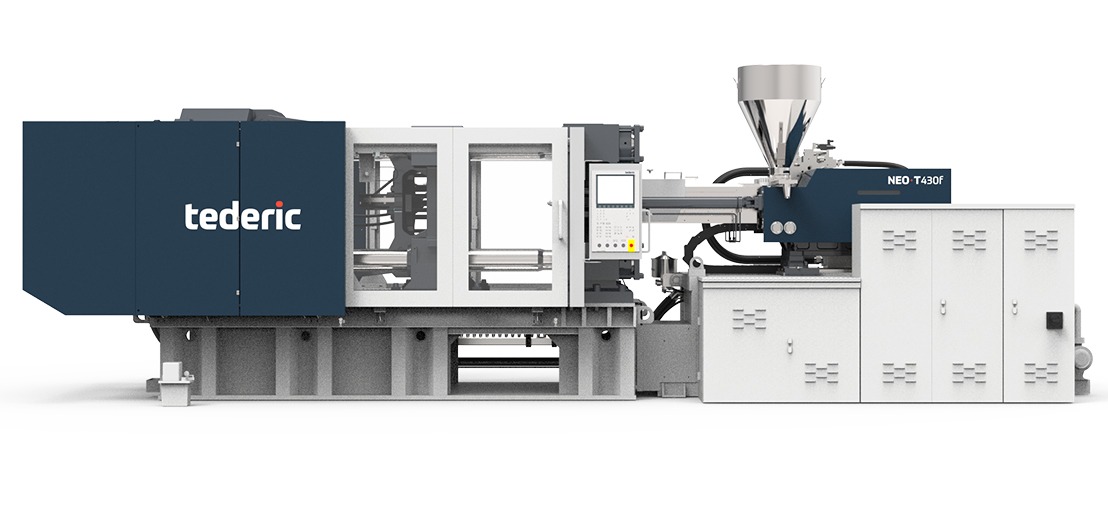



Injection molding machines have come a long way.
The first IMM, invented in 1872, was just like a big hypodermic syringe with a steam-heated barrel and a hydraulically operated plunger.
Then came electric IMMs in 1983, followed by hydraulic IMMs in the 1990s.
But how are all these machines different from each other? Are electric IMMs really better than hydraulic alternatives? Which one should you choose?
Hold on.
Before you start exploring your answers, you should remember that many traditional assumptions about these machines are becoming less clear.
For example, hydraulics are not always dramatically less efficient, and electrics are not always the obvious choice for every application.
So, what is the reality?
Read this technical guide to better differentiate between these machines.
Key Takeaways
The right choice between hydraulic, electric, and hybrid IMMs depends on energy usage, price, precision, and cleanliness.
Electric IMMs are known for higher energy efficiency, better repeatability, cleaner operation, and lower operating costs.
Hydraulics are best for their lower purchase price, long service life, and cost advantages at higher tonnages.
Hybrid IMMs combine electric efficiency with hydraulic functionality.
Hydraulic vs Electric vs Hybrid IMM | Detailed Comparison
Here is a detailed comparison between hydraulic, electric, and hybrid injection molding machines depending on different technical aspects:
1. Energy Efficiency
| Factor | Hydraulic IMM | Electric IMM | Hybrid IMM |
| Power Usage | Pumps run continuously even when no movement is required | Uses power only when machine movement is required | Servo motors only run when a specific movement is needed |
| Idle Periods | Consume energy continuously | Servo motors can enter a hibernation state | Servo motors can enter a hibernation state |
| Cooling Cycles | Long because of continuous movement | Very efficient because motors remain inactive during cooling | Efficient |
A traditional hydraulic machine operates pumps continuously, even when no movement is required. So, these consume roughly 30% of maximum power during these periods.
On the other hand, electric and hybrid machines use energy only when required.
During cooling cycles, servo motors remain inactive, which reduces the power consumption needed to cool everything down.
Let’s now compare the energy efficiency of all.
Electric injection molding machines are about 50% more energy efficient than their hydraulic alternatives. And the latest servo-hydraulic (hybrid) designs with electric screw-rotate drive are 25% to 30% energy efficient than hydraulic machines.
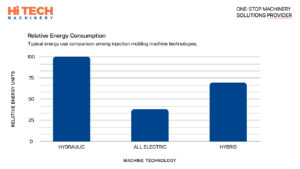
However, these percentages can be different based on which models are being compared.
2. Precision and Repeatability
| Factor | Hydraulic IMM | Electric IMM | Hybrid IMM |
| Precision | Good | Best | Better |
| Repeatability | Good | Best | Better |
All-Electric machines dominate in high-tolerance applications.
Because in hydraulic machines, hydraulic oil changes viscosity as temperature fluctuates throughout a shift, the injection speed and pressure profile can drift slightly.
On the other hand, electric servo motors are governed strictly by digital encoders.
They execute the exact same velocity profile and holding pressure profile stroke after stroke, down to microns of positional accuracy. This virtually eliminates flash and short molds, which means scrap rates are nearly zero.
Electrical machines hold dimensional tolerances as tight as ± 0.01 mm, which can be in the ± 0.2 to ± 0.5 mm range for hydraulic IMMs.
So, electric machines are commonly associated with:
- Better repeatability
- Improved process consistency
- Cleaner operation
- Quieter operation
Interestingly, hybrid machines stand almost toe-to-toe here with electric machines. These show almost the same ± 0.01 mm dimensional tolerances.
Winner: Electric injection molding machines
But hybrids stand just behind in this matter.
3. Maintenance
| Factor | Hydraulic IMM | Electric IMM | Hybrid IMM |
| Oil Management | Required | Not required | Required (but less than hydraulic) |
| Oil Filter Replacement | Required | Not required | Required (but less frequent than hydraulic) |
| Hydraulic servicing | Required | Not required | Required |
| Number of Components | Higher | Lower | Between hydraulic and electric |
Electric machines have fewer moving parts than hydraulic versions.
For example, small hydraulic machines can have about 400 components. In comparison, an electric machine of the same size can only have 100 components.
Electric IMMs, therefore, are easier (as well as affordable) to install.
Hydraulic machines also require:
- Hydraulic oil
- Oil treatment
- Filter changes
- Air bleeding from the hydraulic system
These additional requirements increase maintenance costs and operating complexity.
All-electric molding machines do not use hydraulic oil. All they need is a smaller amount of lubrication grease or oil for routine maintenance for moving parts like ball screws, toggles, etc.
Hybrid IMMs sit between hydraulic and electric machines.
This applies to the number of total moving parts, maintenance, oil management, oil filter replacement, and the maintenance cost.
4. Reliability and Machine Life
| Factor | Hydraulic IMM | Electric IMM | Hybrid IMM |
| Long-Term Operating History | Strong | Debate exists | Depends on design |
| Industry perception | Proven workhorse | Advanced technology | Balance between both approaches |
Hydraulic machines are described as ‘workhorses’ by industry experts.
This is because they can have a long service life.
Hydraulic machines can run for decades if properly maintained. There are manufacturers running hydraulic IMMs that are about 35 years old.
On the other hand, there isn’t much debate about electric and hybrid machines, since they are still relatively new technologies.
These technologies are designed to last for at least 10 to 12 years.
5. Cleanliness and Working Environment
| Factor | Hydraulic IMM | Electric IMM | Hybrid IMM |
| Oil Usage | High | Almost none | Moderate |
| Heat Generation | Higher | Lower | Lower than traditional hydraulic |
| Clean-Room Suitability | Lower | Higher | Depends on configuration |
Hydraulic machines require significant quantities of oil.
For example, a 500-ton hydraulic machine contains about 500 gallons of oil.
Hydraulic oil in such large amounts means there is always going to be some spills on the floor. A hydraulic-based setup is therefore not going to be very clean.
Plus, when oil temperatures rise, this creates a large heat source inside the production area. This makes it difficult for the workforce to work inside the area.
Electric machines eliminate many of these concerns because they do not rely on large hydraulic reservoirs.
Hybrid machines also win here. They act pretty much like electric machines in terms of cleanliness since they use a lot less oil than hydraulic versions.
Do you really want to create clean-room environments?
Electric IMMs should be your first choice if this is the case. Hybrids also work well here.
6. Machine Cost
| Factor | Hydraulic IMM | Electric IMM | Hybrid IMM |
| Initial Purchase Cost | Lower | Higher | Between hydraulic and electric |
| Cost Increase with Tonnage | More linear | Increases significantly as tonnage rises | More balanced |
Price.
This is where hydraulic machines clearly win.
Electric machines cost about 20% to 30% more than the hydraulic machines of the same tonnage, specifications, and performance.
However, this applies to machines under 500 tons.
When you go beyond the 500-ton limit, the cost of electric machines increases dramatically. Because larger servo motors become increasingly expensive.
At this tonnage, the price difference can be 30% to 50% between electric and hydraulic.
For example, a 2000-ton electric molding machine is going to cost TWICE, compared to a hydraulic machine of the same power.
Hybrid machines are also more expensive than hydraulic alternatives, but are more affordable than electric machines.
7. Operating Cost
In terms of operational cost, electric machines are a clear WIN.
Then come the hybrid machines, followed by hydraulic injection molding machines, coming at the last, with the highest operational cost.
That said, here are some numbers to compare operating costs for 386-ton machines:
| Machine Type | Annual Operating Cost |
| Hydraulic | $23,771 |
| Hybrid | $15,903 |
| Electric | $6,698 |
For your information, these figures include the cost of electricity, hydraulic oil, and water.
These numbers mean electric machines deliver the lowest annual operating costs.
Small-Tonnage Vs Large-Tonnage Applications
Machines Below 500 Tons
Electric machines have gained strong acceptance in the below 500-ton range.
Because in this range, users often prioritize:
- Precision
- Repeatability
- Clean operation
- Reduced noise
And electric machines cover and satisfy all the aforementioned aspects.
Machines Above 500 Tons
As machine size increases:
Tolerances often become less demanding
Cost becomes more important
Electric machine prices increase rapidly
The practical break point is around 500 tons, where buyers increasingly evaluate cost versus performance benefits.
If they don’t have to manufacture products related to pharmaceutical or other sectors where extreme cleanliness is required, hydraulic IMMs are preferred.
But remember, electric machines are also available beyond 500 tons.
The Current Industry Direction
The industry does not appear to be moving toward a single machine type.
Manufacturers continue developing:
- All-electric machines
- Servo-hydraulic machines
- Hybrid machines
Some companies are expanding electric technology into larger tonnage ranges, including electric machines up to 950 tons and new developments around 1,500 tons.
At the same time, hybrid systems continue gaining attention because they combine electric efficiency with hydraulic functionality.
The choice between these molding machines depends on the product that has to be made and how much energy one wants to save.
Want to Learn More?
Contact HiTech Machinery then.
HiTech Machinery is the official supplier of Tederic and UWA injection molding machines in Pakistan, the UAE, Saudi Arabia, Oman, Qatar, and the GCC countries.
We supply all types and series of injection molding machines as well as all auxiliaries.
Along with supplying machines, we also handle:
- Installation
- Training
- After-sales support
- Servicing and repairing
- Local warranty
- Spare parts
And much more.
Whether you need to ask something about these types of IMMs (anything) or want to start your manufacturing setup, you can reach out to our team.
HiTech Machinery is a one-stop solution for all your problems related to plastic manufacturing.