


Plastic manufacturing is incomplete without injection molding machines.
We added this statement for a reason.
You pick any product or tool. If it uses plastic in its structure, it means injection molding machines (IMMs) have been used in its manufacturing.
Medical devices, automotives, aerospace, household products, electronic components, etc.
All these sectors are heavily dependent on injection molding.
The current IMMs run very fast, are highly automated, and have the capacity to produce thousands of identical parts with precision.
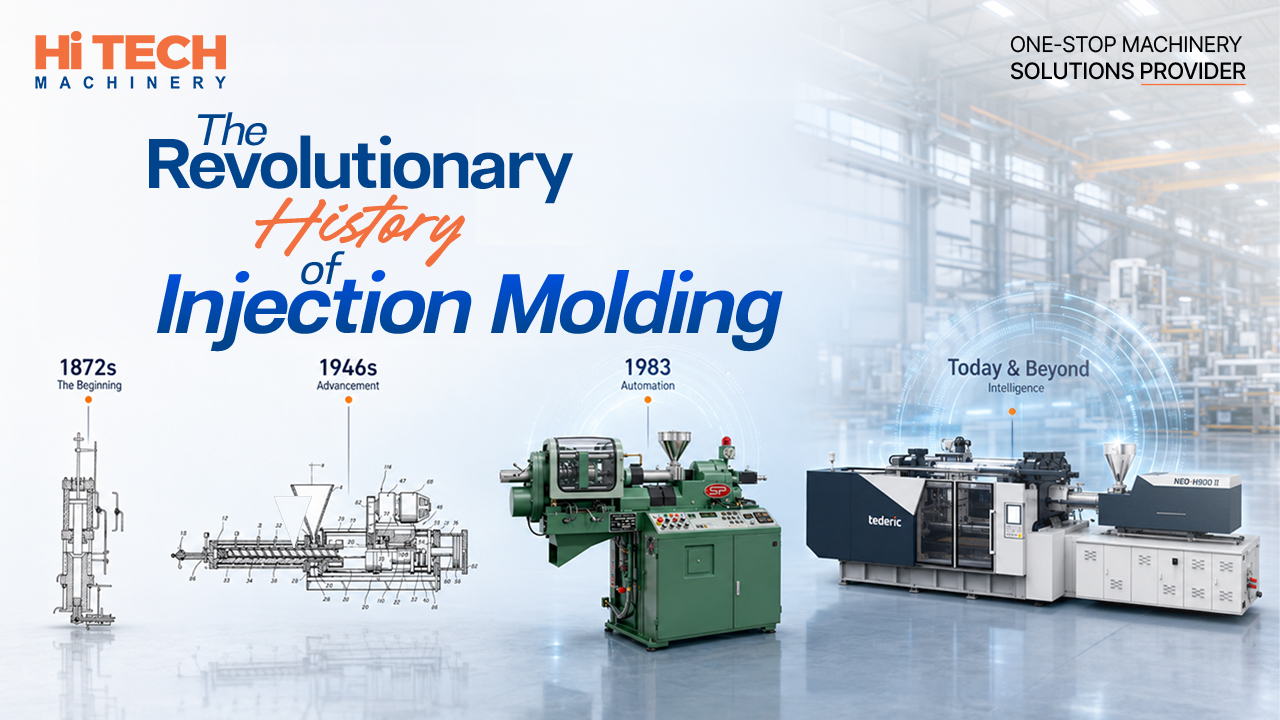
However, the industry did not reach this point overnight. There is a story of more than 150 years behind this and the continued effort of many people.
Let’s have a closer look at it!
The Search for a New Material
The journey of injection molding started with the arrival of the first plastic.
Back in the 1800s, many of the everyday products were made with naturally occurring available materials, such as wood, metal, bone, and ivory.
At some point, this world faced a shortage of ivory to manufacture billiard balls.
Yes, you heard it right.
In search of an alternative synthetic material, American inventor John Wesley Hyatt developed a plastic material called celluloid in 1868.
Although the world’s first commercial plastic had already been invented back in 1861 by the British Alexander Parkes, celluloid became more famous since it was better.
It was less flammable and more affordable to produce.
Entry of First Injection Molding Machine (1872)
Inventing a new material was one side of the coin.
On the second side laid a bigger challenge: finding a method to shape the celluloid efficiently.
John Wesley Hyatt understood this challenge and started working on finding such a method.
In 1872, he and his brother, Isaiah Hyatt, patented the world’s first injection molding machine.

Photo: John Wesley Hyatt, along with the injection machine he and his brother patented. It included a steam-heated barrel and a hydraulically operated plunger
It was very simple compared to the machines used today and worked similarly to a large hypodermic syringe. A heated cylinder melted the celluloid, and a plunger forced the material into a two-part mold.
The machine was able to produce simple products, such as collar stays, buttons, combs, etc.
Hyatt’s invention laid the foundation for the entire injection molding industry.
Plastic Boom and World War II (1930s – 1940s)
In the 1930s, major vinyl thermoplastics were initially developed, which are still used today. For example, polyolefins, PCV (polyvinyl chloride), and polystyrene.
ICI laboratories produced Perspex (polymethyl methacrylate) in this period as well.
Still, at this time, injection molding remained a relatively small industry.
Everything changed during the 1940s.
With World War II came a huge demand for inexpensive materials to replace metal, rubber, and other resources for military purposes.
This demand accelerated both the development of plastics and injection molding technology.
At this time, the chemical industry experienced rapid growth. New plastic materials started to appear at an unprecedented rate.
Polyethylene and nylon are some of the key materials developed during this era.
Now, new plastic materials were available. The injection molding technique was there. And demand was there. The only thing missing was better production equipment.
Then came motorized and hydraulic-powdered injection systems. These machines were able to produce greater force and production speed. These could also produce larger parts than before.
This transition represented a major step forward.
The injection molding industry was beginning to move from a small-scale manufacturing process toward true mass production.
The Introduction of Extrusion Screw Injection Machine (1946)
One of the most significant breakthroughs in injection molding history occurred in 1946.
Traditional plunger machines were unable to mix and melt plastics uniformly.
American inventor James Watson Hendry created the first extrusion screw injection machine in 1946 as a solution to this issue.
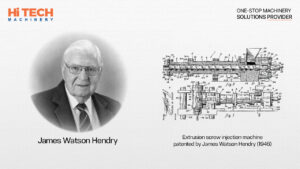
Photo: Extrusion screw injection machine patented by James Watson Hendry
The rotating screw design proved to be much better for melting and injection speed.
Instead of simply pushing material forward with a plunger, the rotating screw simultaneously conveyed, mixed, melted, and injected the plastic.
Nowadays, about 95% of IMMs are screw machines.
Its introduction marked a major turning point in the evolution of plastic manufacturing.
Arrival of the Reciprocating Screw Design (1956)
In 1956, W. H. Willert patented and introduced the reciprocating screw design.
This design mixes the rotation in one design and plunging (by moving backwards and forwards).
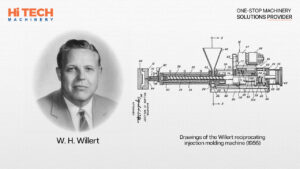
Photo: Drawings of the Willert reciprocating injection molding machine
The first phase in working on this reciprocating screw plasticator is similar to the extrusion screw design. It rotates to ensure plastic resin is melted and mixed properly.
After mixing, the screw stops turning and pushes forward, acting like a plunger to inject material into the mold with higher injection force and volume.
During plastication, the screw moves backward against the hydraulic back pressure.
The Shift to Automation and Precision (1970s–1980s)
The industry kept growing and so did the standards of productivity, quality, and precision.
The era of 1970s and 1980s saw the introduction of electronic controls and automation systems in injection molding machines.
For example, first parts removal robots were used in 1972 in the injection molding process.
With all these innovations, operators had no more to adjust setting through valves, levers, and mechanical controls or even eject parts manually.
An injection molding machine could do all this on its own.
Operators can now use control panels to oversee critical processing parameters.
The impact of digital technology on injection molding was enormous. It marked the beginning of the modern era of precision manufacturing.
The Rise of All-Electric Injection Molding Machines
Hydraulic machines dominated the injection molding industry for many years.
These machines have served humanity but they also had some disadvantages.
For example, their hydraulic pumps ran continuously consuming large amounts of energy. They are not suitable to use in medical and food items manufacturing due to oil contamination risk.
In 1983, Japanese firm, Nissei, introduced the world’s first all-electric injection molding machine, known as MM-5, to overcome all aforementioned issues.
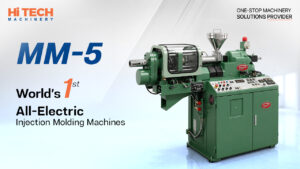
Photo: MM-5 world’s first all-electric injection molding machines
This development represented a major shift in machine design.
Instead of relying on hydraulic cylinders, all-electric machines used high-speed servo motors controlled by digital systems.
The advantages were immediately clear.
Energy consumption dropped dramatically. Many facilities reported energy savings ranging from 50% to 70% compared to conventional hydraulic systems.
The machines also operated much more quietly and precisely.
As a result, all-electric technology became a major part of the industry’s future.
The Current Status of Injection Molding Machines
Injection molding machines have come a long way.
Didn’t they?
Once equipped with only the plunging ability, they now are becoming automated, using advanced artificial intelligence (AI), faster robotic arms, and much more.
Many factories can run around the clock with very little human involvement.
One of the biggest changes is the use of robots.
In many production facilities, robotic arms automatically remove parts from the mold, place them on conveyors, and even prepare them for packaging.
New AI-based smart technologies are coming into view.
Machines can now oversee their pressure, temperature, cycle time, material flow, and other attributes on their own. If something goes outside the required range, the machine can make adjustments on its own and/or alert the operator.
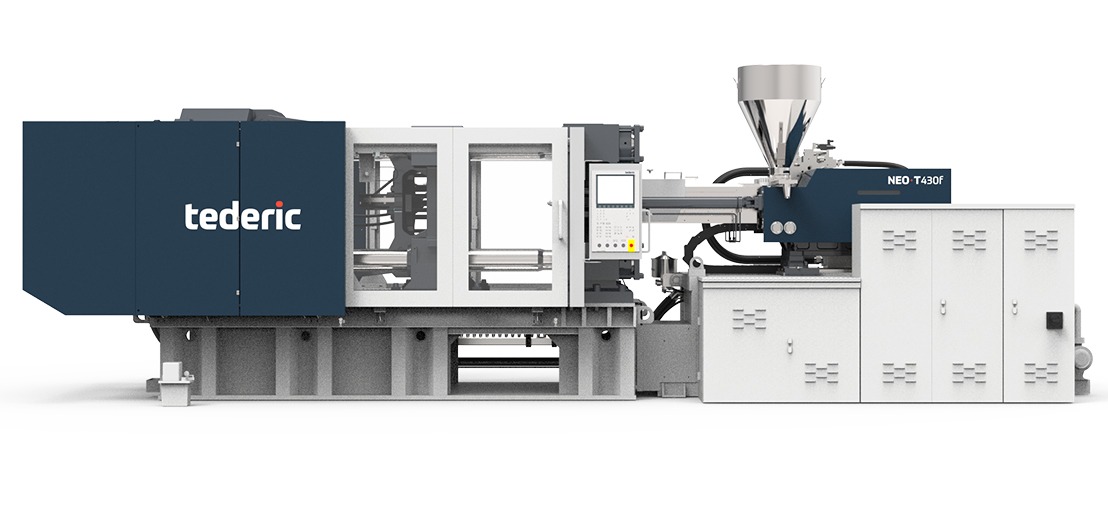
Leading IMM manufacturing brands such as Tederic and UWA are introducing more energy-efficient and automation-friendly machines every year.
Companies like HiTech Machinery are helping manufacturers access these newer technologies, including servo-hybrid systems and fully automated production setups.
Looking ahead, the direction of the industry is quite clear.
More automation, more connectivity, better energy efficiency, and greater use of AI will continue to shape the future of injection molding.