
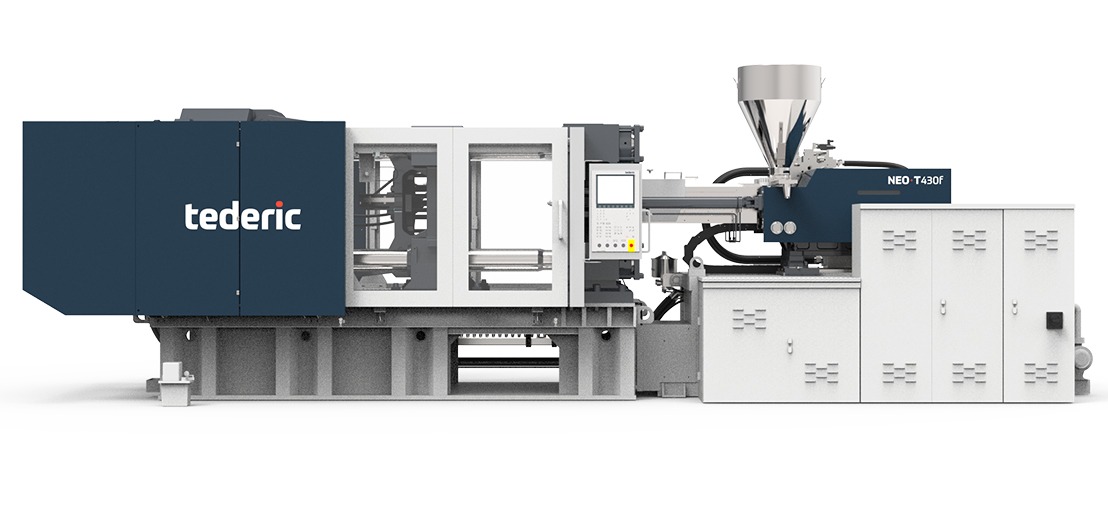



Clamping force is a key term used in injection molding. Because it is the force that keeps the mold closed (tightly) when molten plastic is being injected into it.
It is important to buy an injection molding machine as per the true load and product.
The amount of clamping force required depends on:
- Product size
- Mold design
- Plastic material
- Injection pressure
While it may seem difficult, calculating suitable clamping force is quite easy.
All you need to do is know the formula, understand each entity in it, insert its value, and calculate your answer. That’s it.
Keep reading to learn the whole process fully.
The Science Behind Clamping Force
Let us first understand how an injection molding machine works.
The mold is made of two halves. Before a product is made, the machine closes these two halves tightly. The closing force applied here is known as the clamping force.
Then injection molding happens.
The molten plastic enters the cavity inside the closed mold under high pressure, pushing against the wall in every direction.
One of these forces tries to separate the two halves of the mold.
The clamping unit of the IMM applies enough clamping force to not let two halves of the mold from opening and keeps the mold closed until the plastic cools.
Putting it simply, clamping force keeps the mold fully shut during injection.
What Is the Formula of Clamping Force?
The standard engineering formula to calculate clamping force is:
Clamping Force = Projected Area × Clamping Force Constant (Kp) × Safety Factor
Let’s briefly understand each part.
Projected Area
Projected area is the area of the product seen from the mold’s parting plane, measured perpendicular to the injection pressure’s direction.
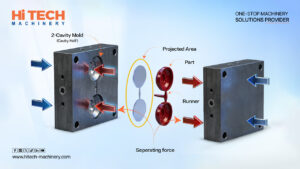
You may confuse projected area with surface area, but they are different.
A product can have a large surface area because of its depth and walls, while its projected area can be much smaller.
NOTE: If there is a runner system, it is a MUST to include its projected area as well. Because it also contains molten plastic during injection.
Clamping Force Constant (Kp)
The clamping force constant (often denoted as Kp) is an empirical multiplier used in injection molding to estimate the cavity pressure of specific plastic materials.
It is fixed, but different for every polymer.
(See the table given below to find out the clamping constant for different polymers.)
Safety Factor
A safety factor provides extra protection.
Production conditions are not always the same; material properties, machine settings, and mold wear can change over time.
A safety factor of 10% is added to tackle all these unexpected changes.
Example | Calculating Clamping Force
Let us see the clamping force calculation with an example.
Suppose you are manufacturing a plastic TV cabinet.
The product has a rectangular projected area, and its dimensions are:
Length = 450 mm
Width = 150 mm
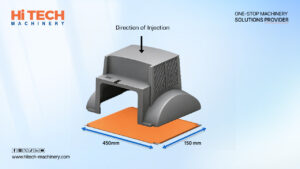
Step 1: Calculate the projected area
Projected Area (rectangle) = Length x Width
= 450 × 150
= 67,500 mm²
Convert it into square centimeters.
67,500 ÷ 100 = 675 cm²
This is the projected area that will be used in the calculation.
Remember, if the mold has runners, their projected area should also be added.
Note: The projected area is different for different products depending on their shapes and sizes. The formulae to calculate the projected area for such products can also be different.
Step 2: Select the clamping force constant
You have to decide on the plastic material for your product and use its clamping constant.
For this calculation, assume the product is made from ABS plastic.
The clamping force constant is 0.30 ton/cm² for ABS plastic.
(A table consisting of clamping force constants is attached below for different polymers. You can see that and find a constant for other plastic materials.)
Step 3: Calculate the clamping force
Clamping Force = Projected Area x Clamping Force Constant
= 675 cm² x 0.30 ton/cm² = 202.5 tons
Step 4: Add a safety margin
Now add about 10% as a safety factor.
202.5 × 1.10
= 222.75 tons
Which Injection Molding Machine to Choose?
All injection molding machines have standard tonnage sizes.
Since there is no 223-ton machine, you should choose the next larger machine.
In this case, a 250-ton injection molding machine would be the right choice.
Many manufacturers follow this approach because it provides enough clamping force without operating too close to the machine’s maximum capacity.
There is also another quick thumb rule used in many factories:
Machine Tonnage = (350 × Projected Area in cm²) ÷ 1000
Using our example:
350 × 675 = 236,250
236,250 ÷ 1000 = 236.25 tons
Again, the nearest suitable machine would be 250 tons.
As you can see, both methods lead to almost the same machine selection, making them useful for practical production planning.
How Does Clamping Force Differ for Multi-Cavity Molds?
Multi-cavity molds mean more molten material injection, more pressure, and more projected area, since there is more vacuum to fill with plastic.
For example, if one product (for one cavity) has a projected area of 10 cm², then:
- 1 cavity = 10 cm²
- 2 cavities = 20 cm²
- 4 cavities = 40 cm²
- 8 cavities = 80 cm²
The runner system should also be included in the total projected area.
Suppose there is a 5-cavity setup with a projected area of 50 cm² per cavity, and the runner adds 20 cm². This means the total projected area will go like this:
(50 × 4) + 20 = 220 cm²
For a multi-cavity mold, using only one cavity during the calculation is a common mistake. Always calculate the projected area of the complete mold.
Different Plastic Polymers & Their Clamping Force Constants
Different plastic materials behave differently during injection molding.
Some can flow easily into the mold while others require much higher pressure to get into every corner of the mold cavities.
Because of this, every plastic polymer comes with a different clamping force constant, as does the clamping force.
Here are the clamping force constants of common plastic materials:
| Material | Clamp Factor (tons/in²) | Typical Processing Temperature (°F) |
| Polyethylene (HDPE) | 3.0 – 4.0 | 400–500 |
| Polyethylene (LDPE) | 2.0 – 2.5 | 350–450 |
| Polystyrene (PS) | 3.5 – 4.5 | 400–500 |
| Polypropylene (PP) | 2.5 – 3.5 | 400–500 |
| Polycarbonate (PC) | 4.0 – 5.0 | 550–650 |
| ABS | 3.0 – 4.0 | 400–500 |
| PBT | 3.5 – 4.5 | 450–550 |
| Polyamide (Nylon 6) | 3.5 – 4.5 | 500–550 |
| Polyurethane (TPU) | 3.0 – 4.0 | 400–450 |
| PVC (Rigid) | 4.0 – 5.0 | 350–400 |
Please note that these values are based on practical production experience and are only general guidelines. The clamping force calculated via these values is only an estimate
The actual requirement can change depending on several factors, including:
- Product wall thickness
- Mold design
- Gate location
- Runner design
- Injection speed
- Packing pressure
- Melt temperature
- Mold temperature
It is always safer to choose a slightly higher machine tonnage rather than one that is too small.