
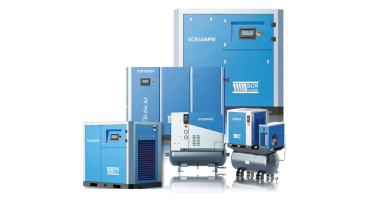



Air compressors are a MUST in pretty much all industries to power machines, increase the production capacity, and bring perfection in the products.
But this one line isn’t enough to fully describe air compressors.
When setting up a manufacturing plant, a manufacturer should also know a few aspects, such as:
Which type is right for your business?
How much pressure do you need?
How often should it be serviced?
And many more.
The good news is that this guide answers all the most common questions about air compressors in one place. In a way that is simple and easy to grasp.
Read this FAQ-like guide to learn more about air compressors.
What Is An Air Compressor?
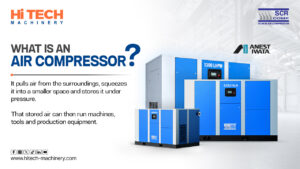
Think of an air compressor as a machine that turns normal air into a source of power.
It pulls air from the surroundings, squeezes it into a smaller space, and stores it under pressure. That stored air can then run machines, tools, and production equipment.
Because it is clean, reliable, and easy to control, compressed air is a key part of many factories.
Which Industries Use Air Compressors?
Air compressors are used in many industries, such as:
- Textile mills
- Plastic manufacturing
- Food processing
- Pharmaceuticals
- Automotive workshops
- Packaging plants
- Chemical manufacturing
- Electronics production
Any industry that uses pneumatic equipment usually depends on compressed air.
What Are the Main Types of Air Compressors?
There are three main types of air compressors.
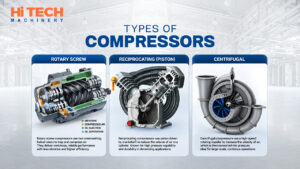
Rotary Screw: Use two intermeshing helical screws (rotors) that spin together to trap and compress air continuously. Best for large-scale, continuous operations.
Reciprocating (Piston): These work like a car engine. Pistons pump up and down to trap and squeeze the air. They are great for smaller shops and intermittent use.
Centrifugal: These use high-speed spinning impellers to build up pressure. They are massive machines designed for heavy industrial plants that need a massive, constant flow of air.
Each type is made for different production needs and operating hours.
What Do CFM, PSI, Bar, and FAD Mean?
These are the numbers that tell you what a compressor can actually handle:
PSI (Pounds per Square Inch) / Bar: This is the muscle called actual pressure. It measures how hard the air pushes. (Note: 1 Bar is roughly 14.5 PSI).
CFM (Cubic Feet per Minute): This is the flow or volume. It tells you how much air the machine pumps out every minute.
FAD (Free Air Delivery): This is the actual amount of useful air the compressor delivers at the end of the line, measured under normal room conditions.
What Size Air Compressor Do I Need?
Never guess this part, but make real calculations; that goes like this:
First of all, look at all the machines, auxiliaries, and tools you want to run. Find that one that requires the highest pressure.
That highest pressure is your minimum PSI limit.
Then, sum up the CFM requirements of all the tools you plan to run at the exact same time.
Take that total CFM number and add a 30% safety buffer so your compressor does not have to work itself to death.
To this point, your current compressor-related requirements have been considered.
You can even consider your future expansion requirements and calculate PSI, CFM, and FAD accordingly.
Select an air compressor accordingly.
Which Air Compressor Is Best for Textile Industries?
Textile mills absolutely need oil-free rotary screw compressors.
Because if even a tiny bit of oil gets into the air lines, it is enough to stain the fabrics and ruin an entire batch of yarn or cloth. Along with being oil-free, being rotary-screw is also a key since these are made to supply continuous pressure at a large scale.
Variable speed (VSD) compression is also important for better energy efficiency.
Why Is My Air Compressor Losing Pressure?
Four common culprits behind an air compressor losing pressure are air leaks, clogged filters, worn-out seals, and demand exceeding capacity.
How Often Should an Air Compressor Be Serviced?
Industrial air compressors must be serviced comprehensively on an annual basis or every 2,000 hours of operation (whichever comes first). But the exact schedule can vary based on the compressor model environment in which it is installed.
What Maintenance Does an Air Compressor Require?
Here is a detailed overview of what maintenance of an air compressor needs and when:
| When | What |
| Daily | Check lubricant levels
Drain condensation from receiver tanks Observe operating temperatures for any sudden changes |
| Weekly | Inspect intake vents
Check drive belts for tension and wear Inspect the system for air leaks |
| Monthly | Clean the coolers
Service/replace the intake air filters |
| Quarterly
(or every 800 to 1000 hours) |
Change the compressor oil and oil filter
Check electrical connections Service/replace the intake air filters |
| Annually
(or every 2000 to 4000 hours) |
Replace separator elements
Grease motor bearings Perform a full system safety and performance check
|
How Often Should Air Filters Be Replaced?
Putting it simply, replace the air filters whenever they become dirty and clogged. And this happens mostly every 3 to 6 months, depending on the environment.
How Can I Reduce Electricity Costs for Compressed Air?
The best way to lower electricity costs is to choose a compressor with a variable speed (VSD) compressor that exceeds IE4 efficiency standards.
Other tactics to lower electricity costs are: fixing air leaks, replacing clogged filters, using the correct compressor size, and servicing the system regularly.
How Long Does an Industrial Air Compressor Last?
An industrial air compressor can last for 8 to 12 years with continuous, 24-hour operation.
For example, rotary screw compressors can last for 7 years (40,000 to 60,000 hours), while centrifugal air compressors can go 11 years (with over 100,000 hours with 24-hour working.
However, the actual lifespan heavily depends upon build quality, operating conditions, maintenance practices, duty cycle, usage intensity, and technological innovations.