



The manufacturing world is changing fast. Most businesses are dealing with higher costs and tougher competition, but some manufacturers are finding real success by adopting the right technology.
One technology that’s making a real difference is rotary extrusion blow molding (EBM). It’s changing the game for plastic bottle manufacturers by completely reshaping their cost structure and production capabilities.
If you’re a manufacturer in the chemical, lubricant, agrochemical, or detergent sectors still relying on conventional linear systems, this could be your most important business decision this decade.
What is Extrusion Blow Molding?
Extrusion blow molding (EBM) is a manufacturing process where molten plastic is extruded through a die head to form a parison (a hollow tube of molten plastic).
This parison is then captured by a mold, and compressed air is blown into it, expanding the plastic to take the shape of the mold cavity. Once cooled, the finished container is ejected.
If we classify EBM machines, you’ll find them in two configurations:
Linear Extrusion Blow Molding
Traditional linear EBM machines arrange stations side by side in a sequential layout. Station 1 handles extrusion and mold closing, Station 2 performs the blowing process, and Station 3 handles cooling and ejection.
Each station operates in a stop-and-go cycle; one stage must be completed before the next begins. Think of it as a relay race where each runner waits for the baton.
Rotary Extrusion Blow Molding
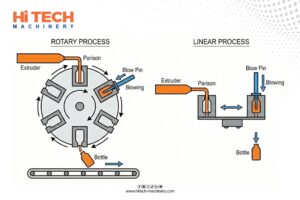
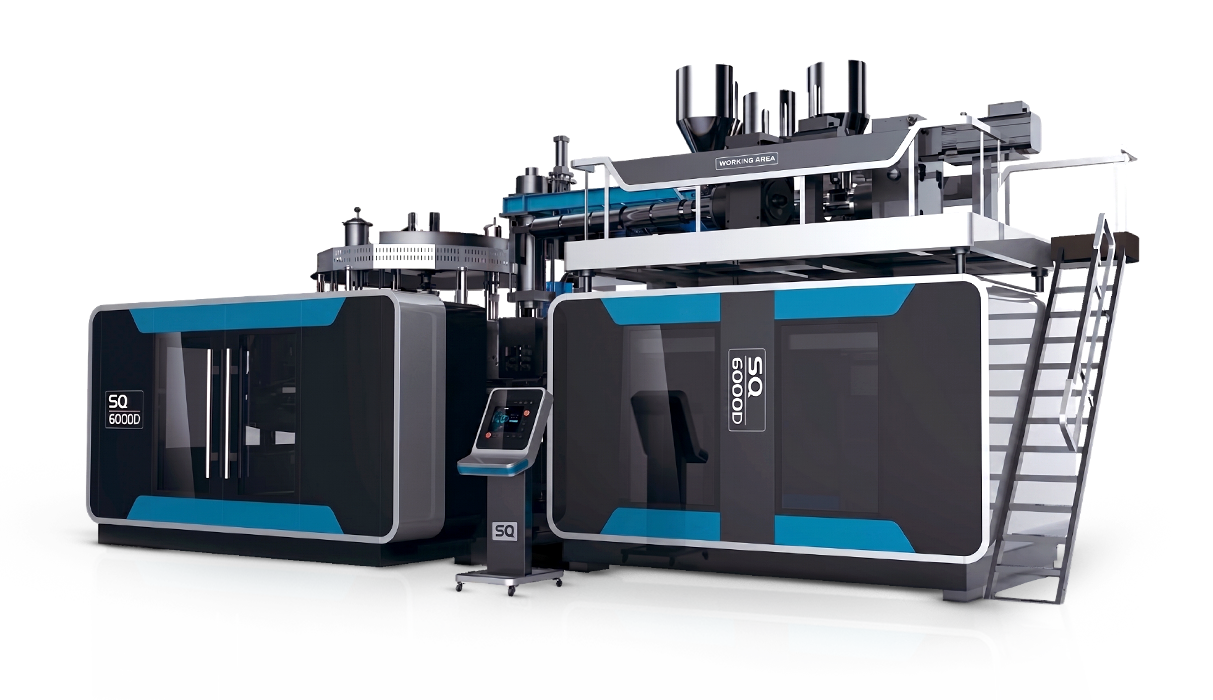
Rotary machines revolutionize this by placing multiple stations on a continuously rotating circular platform.
As the platform rotates, each station performs a different stage simultaneously: one captures the parison, another blows air, another cools, and another ejects the finished product.
The rotation never stops, creating a continuous production flow. It is like a carousel where every seat is occupied and active at all times.
This fundamental architectural difference, from sequential to simultaneous processing, is what unlocks the productivity and efficiency gains that follow.
The Hidden Cost of Staying Linear
Linear extrusion blow molding machines have served the industry reliably for decades. They’re familiar, affordable, and functional. But functionality and profitability are not the same thing.
Running multiple linear EBM machines means more floor space, dedicated operators, and separate utility (water, air, and electricity) consumption. Even optimized operations hit a ceiling, not from lack of capability, but from the fundamental limitations of linear systems.
Your cost per unit plateaus. Competitors quote lower prices. Clients demand faster delivery. Scaling means another machine, more operators, and facility expansion, a costly proposition with diminishing returns.
The FUDL 6-Station Rotary Advantage: Beyond Speed
Rotary systems use a continuous circular platform where multiple processes happen simultaneously. While one station captures a parison, another blows air, another cools, and another ejects, all at once. The wheel never stops. Production flows continuously.
This delivers four critical economic advantages:
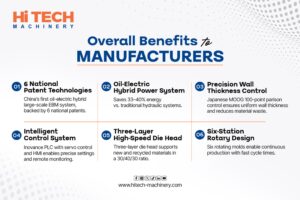
- Production Multiplication: A single 6-station rotary EBM replaces up to seven linear machines. Production gains range from 300% to 700%, depending on your current setup.
- Space Efficiency: Rotary machines occupy the same footprint as two linear machines but deliver an output of 6. Scale production without expanding your facility, or repurpose space for warehousing and quality control.
- Labor Optimization: Consolidate operations instead of managing teams across multiple machines. Redeploy human capital toward quality assurance, maintenance, and process optimization.
- Utility Economics: Rotary systems use 30-40% less water and air per cycle while producing significantly more units. At thousands of containers daily, this creates substantial monthly savings.
The Material Cost Revolution: Multi-Layer Technology
Rotary EBM machines support the latest multi-layer die head construction, a game-changing cost reduction strategy.
Design three-layer bottles: virgin plastic on outer and inner surfaces, recycled material in the core. This “sandwich structure” delivers:
Raw Material Savings: Recycled plastic costs around 40 to 60% less than virgin resin. Using it in the core layer reduces material costs by 35 – 40% per unit without compromising integrity.
Sustainability Credentials: Demonstrate recycled content usage without sacrificing quality. That opens doors to environmentally conscious clients and premium segments.
Regulatory Readiness: Many regions are mandating minimum recycled content. Multi-layer technology positions you ahead of compliance curves.
Brand Differentiation: In commodity markets, sustainability becomes a differentiator. You can sell the narrative of being a sustainable manufacturing company.
Who Should Seriously Consider This Investment?
Rotary systems require a $450,000-900,000 investment, depending on specifications. However, capital cost is only one factor. The real question: what does this investment enable?
This technology makes strong strategic sense for manufacturers with a high-volume demand who struggle to meet delivery deadlines or are forced to turn away orders due to limited capacity.
Or for brands/companies serving industrial markets such as chemicals, lubricants, agrochemicals, and cleaning products, where large-volume orders and price-sensitive buyers are prevalent.
Manufacturers facing intense competitive pricing pressure, particularly from competitors who have already adopted advanced production technology, can use this solution to maintain and strengthen their market position.
It’s not for manufacturers who are doing batch production of certain brands, and often need to change molds on a daily basis. Since rotary extrusion blow molding machines have six mold stations, changing them would be challenging, and getting new molds for separate use is also cost-intensive.
The Integration Opportunity: From Bottle to Filling
Most of the manufacturers often need to fill these cans as well. However, with linear machines, it would take multiple machines to fulfil the capacity of a filling line. A rotary EBM producing 7,000 containers daily can solve a new challenge.
2 to 3 EBMs in sync can be attached to the filling line to create a fully automated solution, from bottle making to filling.
Why HiTech Machinery Is Your Strategic Partner
HiTech Machinery is the exclusive authorized distributor of FUDL rotary extrusion blow molding machines across the GCC and Asian markets. We are also expanding our partnerships with leading filling line manufacturers to deliver a fully integrated solution for bottle production and filling.
We provide complete lifecycle support, including installation, commissioning, after-sales service, technical assistance, maintenance and repair, spare parts, and local warranty.
Having proudly served over 2,000 plastic product manufacturers worldwide, we are now ready to further expand industry horizons with rotary EBM technology.
The Path Forward
The plastic container manufacturing industry is at an inflection point. Manufacturers optimizing linear systems fight for incremental gains. Those embracing rotary technology are repositioning their entire business model.
Manufacturers who will dominate regional markets over the next decade are making these decisions now. Waiting for “perfect conditions” means falling behind competitors already scaling.
If you’re manufacturing containers for chemicals, lubricants, agrochemicals, detergents, or similar industrial products, the question isn’t whether rotary technology will become standard; it’s whether you’ll lead that transition or react to it.